
How Much Reclaimed Wood Do I Need? Usable Yield, Waste Factor, and Ordering Right

A good reclaimed wood order starts with more than a tape measure. You need to know the area you’re covering, the pattern you want, and how much of the specific lot will be usable after sorting and milling.
That last part matters. Unlike new lumber, reclaimed stock is finite and each lot has its own mix of widths, lengths, condition, and character. If you run short, finding more of the same material later may not be possible.
Here’s how to plan your quantity before you order, without relying on a one-size-fits-all waste percentage.
First, understand usable yield
There are two separate quantities to think about:
- Project coverage: the finished area you want to cover.
- Usable yield: how much finished, installable material the lot will provide after processing.
A rough board’s starting dimensions don’t tell you exactly how much finished flooring or wall coverage you’ll get. Sorting, cleaning, milling, and cutting can all change what remains usable.
Ask the supplier to estimate the usable coverage after processing for the specific lot. That gives you a more meaningful number than the starting quantity alone.

Measure the area you want to cover
For a wall
Measure the wall’s width and height, then multiply:
Wall area = width × height
For example, a wall that’s 12 feet wide and 8 feet high has 96 square feet of face area. Subtract large openings, such as a window or doorway, that won’t receive wood. Note smaller cutouts, outlets, switches, trim, and built-ins so the installer can plan the layout.
For a whole room, measure each wall separately. Don’t assume all four walls are the same size, especially in older homes.
If you’re planning a reclaimed focal wall, share a sketch or clear photos, too. The direction of the boards and the placement of corners and trim can affect how the material is laid out.
For a floor
Measure each room’s length and width, then add the room areas together. Include closets and any connected areas that will receive the same flooring. List thresholds and transitions separately; they may need their own trim or milling.
For an irregular room, divide the floor into smaller rectangles, calculate each one, and add them together. If you’re working around a fireplace, stairs, cabinets, or other fixed features, mark them on your sketch rather than relying on a quick estimate.
Random-width flooring needs a little extra attention. Use the finished face widths and the width range the supplier expects to provide. If the boards range from narrower to wider, don’t base your coverage estimate on the narrowest board; ask for a realistic average or midpoint and how the widths will be distributed.
Waste factor: why there’s no single right percentage
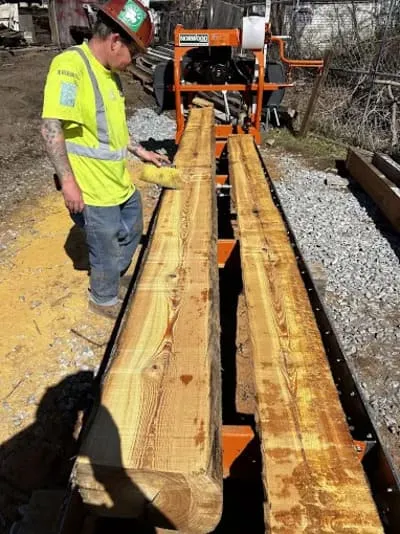
Reclaimed wood can lose usable material to splits, nail holes, crooked edges, end cuts, short lengths, milling, sorting, and boards that don’t meet the needs of your installation. How much is affected varies by lot and by project.
A clean, straight floor layout may use material differently from a wall made with weathered, irregular boards. Patterned layouts also create more cuts than straight runs. So I don’t want to give you a universal waste factor that could be too low, or needlessly high.
Instead, ask these questions about the actual lot:
- What is the estimated usable coverage after processing?
- What are the finished thicknesses and face widths?
- How do board lengths vary?
- Which character marks or defects will remain visible?
- Is the quoted quantity raw stock, milled material, or finished coverage?
- Can we set aside material from this same lot for future repairs?
If you’re buying ready-to-install flooring, confirm whether the quoted square footage is net usable material. Then talk through the extra material needed for the room’s layout and cuts. If you’re buying rough stock, get the supplier’s usable-yield estimate before calculating your order.
Don’t count the same loss twice. If the quote already reflects usable coverage after milling, don’t apply a second allowance for the same milling loss. Ask what the quoted quantity includes.
Check how the wood is priced
Reclaimed material may be quoted by the board foot, square foot, linear foot, piece, or lot. A board foot measures volume:
Board feet = thickness in inches × width in inches × length in feet ÷ 12
That isn’t the same as finished square-foot coverage. Ask what the dimensions and quote include, then compare the cost of usable finished material, not just the starting sticker price. For more on pricing and yield, see our related reading on architectural salvage in Massachusetts.
Your pattern changes the math
Before you order, decide how you want the boards to run. The same wall or floor area can require a different material plan depending on the design.
- Straight runs: Often the simplest layout to measure and plan.
- Vertical or horizontal boards: Board direction changes where pieces need to be cut and how they finish at edges.
- Shiplap or board-and-batten: Profile, spacing, trim, and the finished face width all matter.
- Herringbone or chevron: Angled cuts and pattern alignment can increase offcuts. Have the installer or supplier estimate the added need for your particular design.
- Picture-frame borders: The border and field may need different widths or lengths, so measure and plan them as separate parts.
- Mixed-tone designs: Sorting boards by color or grain may affect which pieces work where.
A quick sketch of the pattern can prevent a lot of guesswork. If the layout is still changing, hold off on placing a final order until you’ve reviewed the design with the person doing the work.
Plan for acclimation and storage
Order the material early enough to follow the flooring manufacturer’s and installer’s requirements. Keep it dry and protected, off the floor, and supported so it stays flat. If the material needs to be stacked for air circulation, follow the supplier’s instructions for that product.
For flooring, the building and subfloor conditions matter as much as the time the boards spend in the room. The National Wood Flooring Association’s installation guidelines explain that flooring should be suited to the home’s expected in-use conditions and checked alongside the subfloor. The wood is ready when the moisture conditions are appropriate, not just because a certain number of days has passed.
Reclaimed flooring can have specific requirements, so review the guidance with your installer and follow the material manufacturer’s instructions.
If you’re processing reclaimed stock yourself
Take care before sanding or machining old boards. Reclaimed wood can hide nails, screws, or other metal. Inspect the boards and use a metal detector before putting them through machinery.
Older paint may contain lead. If painted material is involved, don’t casually sand or machine it. Review Massachusetts lead-safe renovation guidance and consult a qualified professional about safe handling.
When it helps to bring in a pro
Get help if the work affects historic details, requires custom milling, or involves structural elements. A professional can review the material, the layout, and the installation conditions before you commit to an order.
I work with reclaimed lumber and custom-made flooring, and I install on site in Massachusetts. Shipping is available to other states. If you’re choosing between lots, I can also bring sample boards to you so you can see the wood in your space.
A simple ordering checklist
Before you buy, gather:
- Room or wall measurements, including closets and openings
- Photos of the project and nearby trim or existing flooring
- Your preferred board direction and pattern
- The finished board widths and thicknesses you need
- The supplier’s usable-coverage estimate for the specific lot
- A plan to reserve same-lot material for future repairs, if available
- Storage, delivery, and installation timing
Reclaimed lots are unique, so reserve material for future repairs from the same lot when you can. Even a small set-aside may be hard to replace later with a board that has the same character and dimensions.
Bring me your measurements
Send your measurements and photos, and I’ll help estimate usable coverage for the actual lot you’re considering. That’s a real answer based on the material, not a guess based on a generic percentage.
Request a free estimate (there’s no consultation fee), call (978) 210-0221, or email sam@toytownvintagesalvage.com. You can also browse the gallery or find more project guidance on the blog.
Safety note: Reclaimed mantels must be installed with the clearances required by the fireplace manufacturer and local code. Don’t assume a reclaimed beam is safe to use as a structural member; have a qualified professional assess structural use and installation.